Advancing Open Science with Community-Driven Publishing

The C4OS series is an OpenAIRE initiative on how to create an equitable and sustainable model for Open Science.

More than 660,000 outputs, including 435,000 Open Access publications and data sets are now available.

OpenAIRE's new collaboration with Triple contributes to OS and OA practices throughout Europe.

The survey is conducted by the Federation of Finnish Learned Societies (TSV) for the Landscape analysis of GraspOS.
OpenAIRE organised a webinar on the Open Access to Publications Mandate in Horizon 2020. The webinar was run by Inge Van Nieuwerburgh (UGent) en Emilie Hermans (UGent).
How to comply with Horizon Europe mandate for publications
All peer-reviewed scientific publications relating to the results of your Horizon Europe project must be made available in Open Access. This means that the publication must be freely available online immediately upon publication, through a trusted repository, and under an open licence that permits access and reuse to retain sufficient rights.
The key elements of the mandate are:
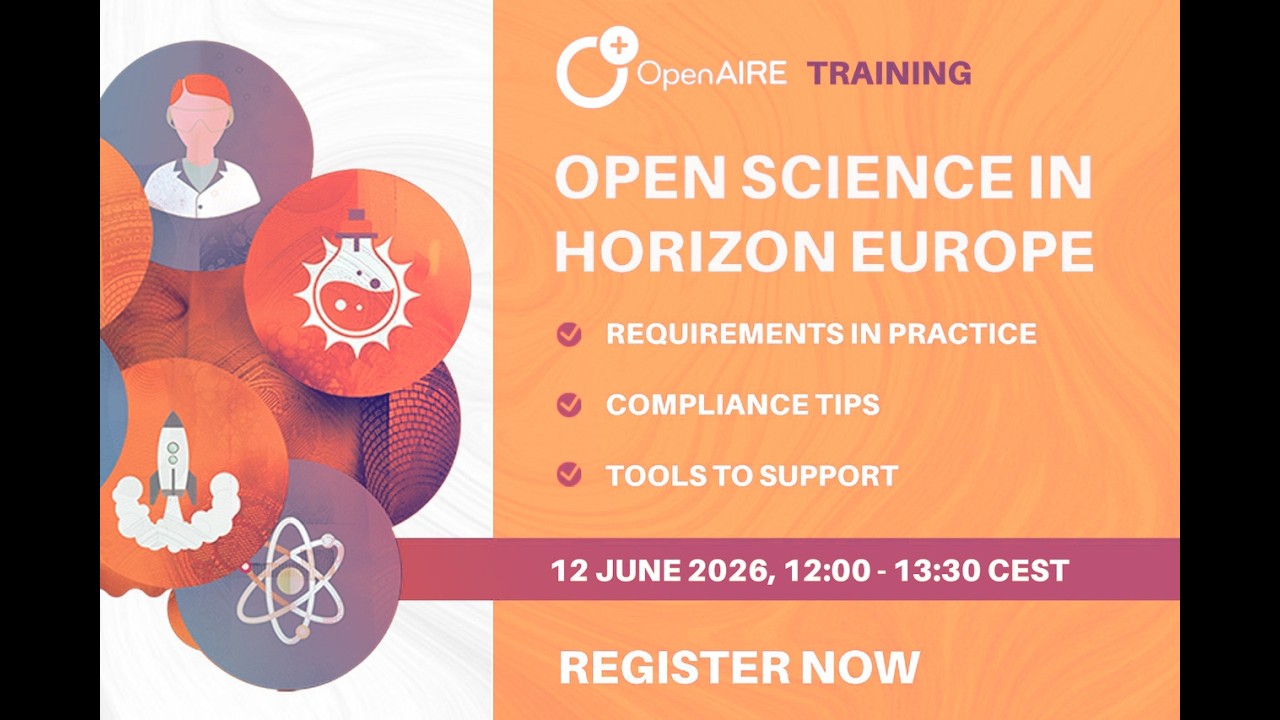
The next sections explain what each of these requirements means in practice and what you need to do to comply.
Think about Open Access before you submit your work:
The Open Access requirement needs to be taken into account before choosing a publisher and submitting your manuscript. The publication route you choose, the version you will make available, the rights you retain, the licence you apply and the publishing agreement you sign can all affect your ability to comply.
These issues can be difficult to resolve retrospectively if they have not been considered in advance. A section of this guide is therefore dedicated to what you can do if you have already published your work and subsequently discover that you cannot make it openly accessible as required.
The Horizon Europe Open Access requirement applies to peer-reviewed scientific publications relating to the results of your project. Your publication falls therefore under the mandate if both:
There is no stated minimum funding percentage within the official documentation. The relevant criterion is whether the publication relates to results of the Horizon Europe action, or whether the data were generated in the action.
In practice this means that publications resulting from research partly funded by the grant, will also have to comply with mandate on the Open Access to publications.
Yes, peer-reviewed monographs and other long-text publications can be covered by the requirement. The Horizon Europe requirements specifically provide for long-text publications and allow some additional licensing options for them compared with journal articles.
For a book or monograph, therefore, the relevant question is not simply “Is this a book?” but: Has this publication undergone peer review as part of its publication process?
Important: Chapters in an edited book of various authors are considered as separate articles under the mandate.
PhD theses are considered peer-reviewed if they are formally published through a publisher.
If you are unsure whether a particular publication type or publication process counts as peer-reviewed, check with your publisher or research support service before publication.
It can. A conference paper or article published in conference proceedings is covered if the individual contribution has undergone peer review.
What does "peer-review" mean in this context?
The European Commission specifies peer-review as "the assessment of manuscripts or publications by researchers with relevant expertise. An article is considered to be peer-reviewed when it has been scrutinized and approved by expert researchers. The number of the positive assessments required is set by each publishing venue." (Annotated Grant Agreement v1.0, Annex 5.6).
The fact that a conference paper was selected for presentation is not, by itself, sufficient. For example, a conference may select submissions based on an abstract or a preliminary screening without conducting peer review of the full paper. In that case, the selection process alone does not make the resulting contribution a peer-reviewed publication.
Check what was actually reviewed: was the manuscript or article itself assessed by reviewers before publication?
Non peer-reviewed work such as technical reports, policy briefs, white papers, training and educational materials, conference abstracts/posters/presentations, guidelines, case studies, etc. do not have to be made openly available, but the European Commission encourages beneficiaries to provide open access to all publications.
An important distinction to understand from the outset is that publishing in Open Access and making a publication available in Open Access are two different things.
Horizon Europe does not require you to publish in an Open Access journal or to pay an Open Access publication fee (i.e. Article Processing Charges). You can choose any publishing venue, including a subscription-based or hybrid journal, provided that you can make the required version of your publication openly accessible through a trusted repository.
Making your work available in Open Access is required regardless of where you publish. Simply publishing in an Open Access journal does not remove the need to comply with the repository requirement.
In other words, there are two separate decisions you need to take:
It is not about where you publish, but where you make your work available in open access.
Once you know that your publication is covered by the Horizon Europe Open Access requirement, you need to decide how you will make it openly accessible.
The key issue is whether you retain sufficient rights to make your publication openly accessible under the required licence. Publishers deal with authors' rights and the different versions of a publication in different ways.
This is why the licence and the rights you retain need to be considered before you submit your manuscript. The route you choose affects which publishing venues you can use, which version of the publication you will make available, and whether Open Access costs can be charged to the Horizon Europe grant.
For journal articles, Horizon Europe requires the openly accessible version to be made available under a Creative Commons Attribution (CC BY 4.0) licence, or an equivalent licence that permits the required reuse. This means that users can read, share and reuse the publication, provided they comply with the licence conditions, including attribution to the authors.
Retaining sufficient rights allows you to apply a CC BY licence to the required version of your publication. This means that you can make that version available:
This is why it is important to consider your rights and the licence before signing a publishing agreement. If you transfer rights to a publisher without retaining the rights needed to comply with Horizon Europe, it may become difficult to meet the Open Access requirement.
Simplified, you have mainly two routes:
You can publish your article in a fully Open Access journal or publishing platform. The publication is then openly accessible from the publisher's website, rather than being made available only to subscribers.
Some charge Article/Book Processing Charges, while others are completely free for the authors (i.e. so-called Diamond Open Access publishing venues). Open Research Europe, the European Commission's publishing platform, is one example of a Diamond Open Access publishing platform available to all Horizon Europe grantees.
Even when your article is openly available on the publisher's website, the mandate requires the publication to be deposited in a trusted repository.
Common characteristics (might differ depending on you particular case):
| Common characteristics | |
|---|---|
| Openly readable on the publisher's website | Yes |
| Openly readable on the repository | Yes |
| Open Access fee (APC/BPC) | Yes / No if a diamond venue |
| APC/BPC covered by the grant | Yes |
| Openly accessible version | Version of Record (i.e. publisher's version) |
| Licence applied to the openly accessible version | CC BY |
| The publication has to be uploaded on a repository | Yes |
Important: “Open Access venue” means that the entire venue is fully Open Access. A subscription journal that gives you the option of paying an additional fee to make your individual article Open Access is called a hybrid venue. The distinction matters because the publication fee for a hybrid venue is not an eligible Horizon Europe cost.
💡‘Mirror’ and ‘sister’ journals are fully Open Access versions of existing subscription-based journals, typically sharing the same scope, editorial boards, and peer-review processes, while providing an alternative route for publishing research openly. Under Horizon Europe, they are considered as fully Open Access journals (i.e. not hybrids).
You can publish you article in a traditional subscription-based journal. There are usually two cases:
This fee is not eligible for reimbursement from your Horizon Europe grant. You need to find the funds to pay for the APCs independently. This is different from publishing in a fully Open Access venue, where eligible publication fees can be charged to the grant.
| Common characteristics | |
|---|---|
| Openly readable on the publisher's website | Yes |
| Openly readable on the repository | Yes |
| Open Access fee (APC/BPC) | Yes |
| APC/BPC covered by the grant | No |
| Openly accessible version | Version of Record (i.e. publisher's version) |
| Licence applied to the openly accessible version | CC BY |
| The publication has to be uploaded on a repository | Yes |
You might need to use the Rights Retention Statement if the publisher's standard terms do not give you sufficient rights to make the required version openly accessible under a CC BY licence.
| Common characteristics | |
|---|---|
| Openly readable on the publisher's website | No |
| Openly readable on the repository | Yes |
| Open Access fee (APC/BPC) | No |
| APC/BPC covered by the grant | - |
| Openly accessible version | Usually the Author Accepted Manuscript (i.e. the authors' peer-reviewed version before copy-editing) |
| Licence applied to the openly accessible version | CC BY on the Author Accepted Manuscript; a different licence might be signed for the Version of Record |
| The publication has to be uploaded on a repository | Yes |
There is no single route that is right for every publication. Your choice may depend on the journal you want to publish in, the version that can be deposited, the rights you can retain, publication costs and other considerations specific to your discipline.
In both cases, the licence is central: you need to retain sufficient rights to make the required version of your publication available under an open licence. For journal articles, this means applying a CC BY licence (or an equivalent licence permitted by the grant agreement).
The important thing is to make this decision before submitting your manuscript, rather than assuming that the Open Access requirement can be dealt with after publication.
Horizon Europe mandate for publications requires you to make either the published version of your publication or the final peer-reviewed manuscript accepted for publication openly accessible through a trusted repository.
The two versions are:
The Version of Record (VoR) is the final version of the publication as formally published by the publisher. It includes the publisher's final formatting, copy-editing, typesetting, pagination and other changes made during the publication process.
If you retain your rights on the VoR by applying an open licence, you can deposit this version in a trusted repository.
The Author Accepted Manuscript (AAM) is the version of your manuscript that has incorporated the changes resulting from peer review and has been accepted for publication, but has not yet undergone the publisher's final copy-editing and typesetting.
The AAM is sometimes also called the accepted manuscript, author's accepted manuscript, postprint or final peer-reviewed manuscript.
If you use the AAM, this is the version that needs to be made openly accessible in the repository under the required licence.
The choice will depend on which version you retained your rights on (i.e. the one you applied an open licence to). If it was on the Version of Record, most people will share that version because it is 'nicer-looking' than the Author Accepted Manuscript.
If you retained your rights on the AAM, then you would only be able to share that version. The publisher is probably the rights' owner of the Version of Record.
Do not confuse the AAM with a preprint. A preprint is a version of a manuscript made available before peer review and acceptance. The Horizon Europe requirement refers to the final peer-reviewed manuscript accepted for publication, not simply any version of the manuscript.
This is why the version, rights and licence should be considered before you submit your manuscript, rather than after the publication agreement has been signed.
To comply with the Horizon Europe Open Access requirement, you need to retain sufficient intellectual property rights to make the required version of your publication openly accessible under the required licence.
For journal articles, this means that you need to be able to make the required version available under a CC BY 4.0 licence (or an equivalent licence). You therefore need to ensure that you are selecting this specific licence before signing a publishing agreement.
Reminder: For journal articles, the mandate does not allow you to apply a more restrictive licence such as CC BY-NC (non-commercial), CC BY-ND (non-derivatives), CC BY-SA (share-alike), etc.
For monographs and other long-text publications, Horizon Europe allows more restrictive licences to be applies, such as CC BY, CC BY-ND (non-derivatives), CC BY-NC (non-commercial), or CC BY-NC-ND licences. The CC BY-SA (share-alike) is not a valid option.
💡 A chapter in an edited book is treated as a scientific publication/article rather than as a monograph for the purposes of the Horizon Europe mandate. The required version therefore needs to be made available under a CC BY 4.0 licence.
A publisher can ask you to grant it exclusive rights to publish and distribute your article, meaning that you cannot give another publisher the same exclusive publishing rights. This is common in scholarly publishing and does not necessarily mean that you have to transfer copyright to the publisher.
A publisher may also ask for other rights, depending on its publishing agreement. Before signing, check exactly which rights you are transferring or licensing and, in particular, whether the rights holder retains sufficient rights to make the required version of the publication openly accessible under the required licence.
Not necessarily. The author(s) who wrote the publication is not necessarily the person or organisation that owns its copyright. For example, your institution may own the copyright under the terms of your employment or national law.
What you need is sufficient rights to fulfil the Open Access requirement. These rights may be retained by you, your institution or another beneficiary, depending on how ownership and publication rights are arranged.
This is where the 'Rights Retention Statement' can be important. It provides a way for beneficiaries to retain the rights necessary to comply with the Horizon Europe Open Access requirement, rather than relying solely on the publisher's standard terms.
It is a statement that needs to be added from the very first submission of the manuscript, and kept throughout the peer-review process until the work is published. This allows you to retain sufficient rights on the Author Accepted Manuscript, even if you sign a Copyright Transfer Agreement on the Version of Record.
The next section expands on how to implement practically the Rights Retention Statement.
The Rights Retention Statement is a way of notifying the publisher, from the outset, that your manuscript is subject to the Horizon Europe Open Access requirements and that you retain the rights needed to make the required version openly accessible under the applicable licence.
The European Commission provides an example of a statement that refers explicitly to the Horizon Europe grant agreement and its Open Access requirements. The wording can be adapted to your project, provided that it clearly informs the publisher of the applicable rights and licensing requirements.
This work was funded by the Εuropean Union under the Horizon Europe grant [grant number]. As set out in the Grant Agreement, beneficiaries must ensure that at the latest at the time of publication, open access is provided via a trusted repository to the published version or the final peer-reviewed manuscript accepted for publication under the latest available version of the Creative Commons Attribution International Public Licence (CC BY) or a licence with equivalent rights. CC BY-NC, CC BY-ND, CC BY-NC-ND or equivalent licenses could be applied to long-text formats.
The European Commission does not prescribe a specific place where you have to put the statement. You can, for example:
The important point is that the statement should be included from the initial submission and retained throughout the publication process, including in successive versions of the manuscript up to the final peer-reviewed version (recommendations from the French Ministry of Higher Education and Research).
Keep a copy of the successive versions of your manuscript containing the Rights Retention Statement. You should also keep correspondence with the publisher concerning your rights, licensing or publishing agreement.
This creates a record showing that the rights-retention notice was present throughout the publication process and can be particularly useful if there is a disagreement with the publisher later.
As an additional precaution, you can make the licence particularly visible by adding:
CC BY 4.0
or
Distributed under a Creative Commons Attribution 4.0 International licence
to the manuscript, together with the CC BY logo. You can keep this notice and logo on the successive versions of the manuscript from submission through to the final peer-reviewed version.
If you intend to publish in a subscription-based journal and rely on repository-based Open Access, consider the Rights Retention Statement before your first submission:
This approach allows you to address the Open Access requirement before the publisher's agreement is signed, rather than trying to recover the necessary rights afterwards.
Journal Checker Tool
Before submitting, you can check your journal in the Journal Checker Tool (JCT).Select "European Commission (Horizon Europe Framework Programme)" as the funder to see the Open Access options and the specific guidance provided for Horizon Europe.
There are a few things you should check before submitting your publication to make sure that it can be correctly identified as a result of your Horizon Europe project and that readers can access the outputs needed to understand or validate your findings.
Your publication should clearly acknowledge the European Union funding and identify the project that supported the work. Include the project acronym and grant agreement number in the publication, following the funding acknowledgement requirements applicable to your grant.
Horizon Europe beneficiaries are also required to acknowledge EU funding and display the EU emblem and funding statement in dissemination activities and results financed by the grant. Check Article 17 of your Grant Agreement for the specific requirements that apply to your project.
In practice: Use the funding acknowledgement recommended by your institution or project consortium and make sure that the project acronym and grant agreement number are included.
If your publication relies on other research outputs, tools or instruments that are needed to validate its conclusions, these should also be made accessible, or information should be provided on how they can be accessed, subject to the applicable restrictions.
This could include, for example:
This does not mean that every output associated with the research has to be included with the publication. The requirement concerns the outputs, tools or instruments needed to validate the conclusions of the publication.
Where these outputs are subject to legitimate restrictions, such as intellectual property, confidentiality or data protection requirements, the relevant Horizon Europe rules apply.
Where possible, link the publication to the related research outputs through persistent identifiers or repository links. This makes it easier for readers to find the data, software or other materials associated with your publication and helps ensure that the different outputs can be connected.
The metadata of the publication deposited in the repository also needs to contain information such as the authors, title, publication date and venue, as well as the Horizon Europe funding information, project acronym and grant number and licensing information. The European Commission also requires this metadata to be openly available and machine-readable.
Keep in mind: The information that needs to appear in the publication itself and the metadata that needs to accompany the repository record are not necessarily the same thing. The repository metadata requirements are covered in the section on depositing your publication.
We organise this webinar every 3-4 months. We update every time with the latest recommendations and information.
Created: June 2022
Updated: August 2026

The National Open Research Forum (NORF), the Irish Research eLibrary (IReL), and OpenAIRE proudly announce the launch of the National Open Access Monitor, a cornerstone in Ireland's shift towards a fully open access research ecosystem.


This award validates our commitment to advancing Open Science.

From June 6 to June 10, 36 participants from 27 countries joined OpenAIRE’s first online interactive Bootcamp.

Showcasing our services and sharing the new developments to support the uptake and development of OA repositories

 Sign up now!
The Munin Conference is an annual conference on scholarly publishing and communication, primarily revolving around Open Access, Open Data and Open Science. This year's conference is the tenth Munin Conference. It will feature distinguished speakers such as Nobel laureate Randy Schekman, Stuart Shieber and Peter Suber. November 30th - December 1st at the University of Tromsø - The Arctic University of Norway.
 What you need to know about the EU’s Open Data and Open Access policies